Competitors
Competitors describe Prinx Chengshan Holdings Limited's market in their own filings and calls. These verified passages and visual pages show where their strategies meet, using source documents preserved in Sources.
Jiangsu General Science Technology Co., Ltd. (通用股份) (601500.SS)
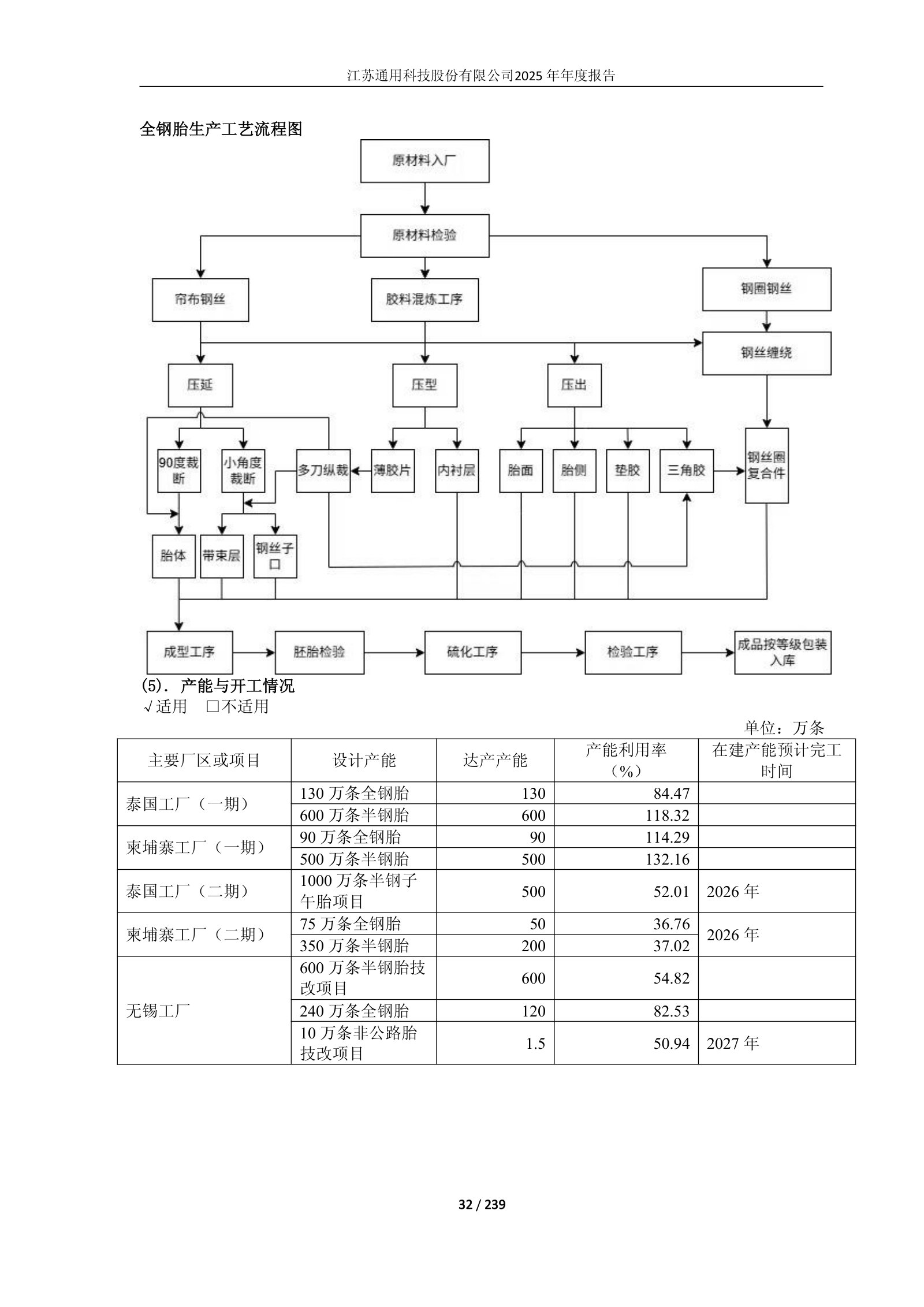
The closest strategic mirror to Prinx Chengshan, and the only peer whose filings name it. General Science runs the same play: a Chinese all-steel/semi-steel maker whose growth sits in Southeast Asian plants (Thailand and Cambodia) selling into the US and Europe, at roughly Prinx's scale (FY2025 revenue RMB8.50bn against Prinx's RMB11.81bn). Its annual report devotes a standing section to tyre trade barriers and discloses the same US truck-and-bus-tyre anti-dumping proceeding in which Prinx Thailand was a mandatory respondent, plus plant-by-plant utilisation for the offshore bases. Only the tyre business is in scope; the Suhao Holdings parent's wider trading operations are not.
A competitor's trade-barrier section naming Prinx Chengshan. First paragraph: in the US Department of Commerce's October 2024 final determination on truck and bus tyres from Thailand, "Prinx Chengshan (Thailand)" received an individual rate of 12.33%; the other mandatory respondent, Bridgestone (Thailand), was assigned 48.39% at the preliminary stage; and General Science's own Thai base, along with all other Thai exporters, took the 12.33% all-others rate. Prinx's own FY2025 annual report confirms the same 12.33% and adds that it has filed for the first administrative review. The read-across is that Prinx's individual rate became the rate every other Thai exporter pays — its defence as a mandatory respondent set the floor for the peers it competes against out of Thailand, and conferred no relative advantage. Second paragraph, elided to the next sub-heading: from 3 April 2025 tyres fall under the Section 232 national-security regime rather than the reciprocal tariff, with USMCA-qualifying Canadian and Mexican tyres exempt; Chinese-made tyres carry 25% on top of the MFN rate, and Vietnamese, Thai and Cambodian tyres carry the 25% Section 232 duty alone. On this account the tariff gap between exporting from China and exporting from Thailand has narrowed to the MFN rate plus any anti-dumping order. These are General Science's own summaries of US and EU measures, not legal texts, and the rates are as of its FY2025 reporting date.
2024 年 10 月,美国商务部公布对泰国卡车和公交车轮胎反倾销调查终裁结果。浦林成山(泰国)单独税率为 12.33%;另一家强制应诉企业普利司通(泰国)初裁单独税率为 48.39%;公司泰国基地与其他泰国出口美国的轮胎企业初裁税率为 12.33%。 […] 2025 年 4月 3日,美国对轮胎行业实施新的关税政策安排,将轮胎产品纳入 232 国家安全关税适用范围,并明确已适用 232 关税的轮胎产品不再叠加执行全球对等关税。该政策覆盖乘用车轮胎、轻卡轮胎等主要轮胎品类,除符合 USMCA 规则的加拿大、墨西哥产轮胎可豁免 232 关税外,其他国家和地区输美轮胎均适用 232 条款相关关税要求。中国产轮胎在原有最惠国税率基础上,加征 232 条款项下 25%的附加关税,越南、泰国、柬埔寨等东南亚国家产轮胎仅执行 232条款 25%的附加关税,不再适用此前拟定的对等关税税率。
p. 14 · Read in context →
General Science on how it is responding to the tariffs above: leaning on strategic relationships with large overseas customers, flexing production plans and order scheduling to keep the two offshore bases running, and pushing hard into non-US markets — Southeast Asia, South America, Central Asia and Africa — with dedicated market-development teams and localised sales and service networks, explicitly to spread the tariff risk. It describes the Thai base as having built a reputation comparable to international brands after years in market, and the Cambodian plant as running strong on both output and sales with phase 2 capacity coming through. Later on the same page the company says it is actively planning a third overseas base. This is management's own characterisation of its position, with no volumes, prices or margins attached; the checkable part is the strategy — diversify away from the US and add a third country — which is the same move Prinx is making with Malaysia.
公司深化“5X 战略计划”,持续践行全球化布局。面对对等关税压力,公司主动作为、多措并举破解发展困境。公司依托与海外头部客户建立的战略合作关系,灵活调整生产策略和订单排期,保障了海外双基地的稳健运营。
同时,公司积极拓展非美市场,加大对东南亚及南美、中亚和非洲等新兴市场的开拓,组建专项市场拓展团队,深入调研区域市场需求特点,搭建本地化营销与服务网络,不断提升品牌认可度和市场占有率,进一步拓宽全球市场布局,分散关税压力带来的经营风险。公司泰国生产基地经过多年市场验证,凭借高性能、高品质、绿色安全的产品,形成了比肩国际品牌的优质口碑;柬埔寨工厂自开业以来,保持着“产销两旺”的良好态势,二期项目的产能潜力逐步凸显,其全过程自动化、智能化、互联化的制造实力,充分彰显“中国智造”的强劲力量,成为提升公司业绩增长的重要引擎。
p. 15 · Read in context →
Triangle Tyre Co., Ltd. (三角轮胎) (601163.SS)
The nearest peer by size and product mix: a Shandong commercial-tyre house whose FY2025 revenue of RMB9.82bn sits just below Prinx's RMB11.81bn, with tube-less commercial tyres over 70% of its truck range and a replacement-market franchise built on the same dealer model. It is also the control case for the offshore question — Triangle reports overseas assets of RMB61.4m, 0.32% of total assets, so its results isolate what happens to a China-only cost base facing the same tariffs. Its industry section is the most granular market sizing in the peer set.
The shared market, sized by a peer. From the National Bureau of Statistics: industrial revenue across large enterprises grew 1.1% in 2025 while profit grew 0.6%, but the rubber and plastics sector saw revenue fall 1.4% and profit fall 5.9% — the industry earned less on more. Chinese rubber tyre casing output including motorcycle tyres was 1.207bn units, up 0.9%. From the China Rubber Industry Association's tyre branch: total automotive casing output 865m units, up 2.1%, with radialisation at 96%; semi-steel passenger tyres 685m units, up 1.5%; all-steel truck tyres 146m units, up 5.0%. Customs data put 2025 exports of new pneumatic rubber tyres at 702m units, up 3.1%, 9.29m tonnes, up 3.3%, and RMB161.123bn, up 1.8% — value growing more slowly than volume, i.e. falling average export prices. Within that, passenger-car tyre exports fell 1.9% while bus and truck tyre exports rose 2.7%. Note that peers do not agree on these figures: Linglong's FY2025 report puts total automotive tyre output at 834m units, down 1.59%, and all-steel at 149m units, up 7.19%, against Triangle's 865m and 146m. The association and customs series are the common source, but the aggregations differ, so use the direction rather than the decimal.
国家统计局数据显示:2025 年全国规模以上工业企业营业收入同比增长 1.1%,利润总额同比增长 0.6%;其中,橡胶和塑料制品业营业收入同比减少 1.4%,利润总额同比减少 5.9%。2025年我国橡胶轮胎外胎累计产量(包括摩托车充气橡胶轮胎外胎)为 12.07 亿条,同比增长 0.9%。根据中国橡胶工业协会轮胎分会的统计,2025 年全国汽车外胎总产量 8.65 亿条,同比增长 2.1%,子午化率达 96%;其中半钢乘用轮胎产量 6.85 亿条,同比增长 1.5%;全钢载货轮胎产量 1.46 亿条,同比增长 5%。
根据海关总署数据,2025 年全年,我国新的充气橡胶轮胎(含摩托车、自行车等用轮胎)累计出口数量为7.02亿条,同比增长3.1%,出口重量为929万吨,同比增长3.3%,出口金额为1,611.23亿元人民币,同比增长 1.8%;其中:机动小客车用新的充气橡胶轮胎出口数量 3.42 亿条、同比减少 1.9%;客车或货运机动车辆用新的充气橡胶轮胎出口数量 1.30 亿条、同比增长 2.7%;建筑业、采矿业或工业搬运车辆及机器用新的充气橡胶轮胎出口数量 0.1 亿条、同比增长 1.9%。
p. 12 · Read in context →
Triangle's own account of the trade environment and its answer to it: the US reciprocal-tariff policy of April 2025, the EU anti-dumping investigation into Chinese passenger and light-truck tyres opened in May with a countervailing investigation added on 6 November, and rate changes or new tariffs in the UK, Brazil, Mexico and Turkey. Management says the company is "moving from passive response to proactive positioning, addressing trade risk through global capacity deployment and lifting core competitiveness through technical innovation". The second paragraph records the China Rubber Industry Association's 15th Five-Year Plan guidance for the rubber sector, issued in October 2025, built around premiumisation, green transition, intelligent manufacturing and international coordination for 2026-2030. Set the stated intent against the disclosure higher up the same page: overseas assets of RMB61.3932m, 0.32% of total assets. At the FY2025 balance-sheet date the global capacity deployment is an intention rather than a built footprint — which is the structural difference between Triangle and Prinx, whose Thai base already carries 2m all-steel and 10m semi-steel sets of capacity.
2025 年 4月,美国政府宣布实施“对等关税”政策;2025 年 5 月,欧盟启动对华乘用车和轻卡轮胎的反倾销调查后,于 11 月 6日正式追加反补贴调查;英国、巴西、墨西哥、土耳其等国家调整反倾销税率或加征关税,中国轮胎对欧美等国家的出口面临新的挑战。面对日益复杂的国际贸易环境,公司正在从被动应对转向主动布局,通过全球化产能布局应对贸易风险,通过技术创新提升核心竞争力。
2025 年 10 月中国橡胶工业协会正式发布了《橡胶行业“十五五”发展规划指导纲要》,明确了未来五年(2026-2030 年)行业发展的总体定位、核心目标和战略路径。《橡胶行业“十五五”发展规划指导纲要》以“高端化引领、绿色化转型、智能化赋能、国际化协同”为主线,全面贯彻国家“十五五”时期国民经济和社会发展的总体部署。公司将以“十五五”规划为指导,以科技创新为核心驱动,对标世界一流企业标准,通过数字技术赋能智能制造、绿色技术推动低碳转型,实现高质量发展。
## (2).主要细分行业的基本情况及公司行业地位
√适用 □不适用
详见本报告第三节 二、“报告期内公司所处行业情况”。
p. 25 · Read in context →
Sailun Group Co., Ltd. (赛轮轮胎) (601058.SS)
The scale setter. Sailun's FY2025 revenue of RMB36.79bn is roughly three times Prinx's, RMB28.23bn of it earned offshore, and it holds the largest overseas manufacturing footprint of any Chinese tyre company. It competes with Prinx in the same all-steel and semi-steel categories, through the same US and European replacement channels, and out of the same Southeast Asian tariff jurisdictions. Its filings and investor Q&A are also the most explicit peer statements of global market structure and of the tariff arithmetic by country of origin.
Sailun's stated view of global market structure, in the outlook section of its FY2025 annual report. Citing Michelin's annual report, it puts Europe and North America together above 50% of 2025 global tyre sales, China's share up to 20.18%, and Africa, India and the Middle East as the fastest-growing sources of incremental volume. On competition, it argues concentration remains high and the international majors still hold relatively high share, but that the picture has shifted materially: per the US trade publication Tire Business's 2025 Global Tire 75 ranking, the combined global market share of the top three producers has fallen to 35%, and the number of Chinese entrants, including Taiwan, has risen to 39. The framing — Chinese producers rebuilding global share, price and supply chains on cost-performance, R&D spending and offshore capacity — is Sailun's. The two share figures are the checkable part, and both are third-party: 35% for the top three is Tire Business's compilation of 2024 sales, and the regional splits are Michelin's. Neither gives Prinx's own share.
根据米其林年报数据,欧美地区仍是全球轮胎最主要的消费市场,2025 年轮胎销量合计占比超过 50%;中国市场依托汽车产业的快速发展实现规模扩容,轮胎销量占比提升至 20.18%;非洲、印度及中东等新兴市场轮胎需求保持较快增速,已成为轮胎销量增加的重要来源。
从市场竞争格局来看,全球轮胎市场竞争格局仍呈现较高集中度,国际轮胎巨头凭借长期积累的技术、品牌、产能与渠道优势,仍占据相对较高的市场份额。但受全球消费需求结构调整、轮胎企业技术持续突破等因素影响,以中国轮胎制造企业为代表的新兴轮胎品牌加快推进全球化布局,全球轮胎市场格局较之前已有较大变化。根据美国《Tire Business》2025 年发布的全球轮胎企业 75 强榜单数据,全球排名前三的轮胎企业全球市场占有率下降至 35%;中国企业(含中国台湾地区)入围数量增加至 39 家。中国轮胎企业凭借高性价比优势、持续加码的技术创新投入,以及稳步推进的全球化布局,全球市场影响力逐步提升,推动全球轮胎行业市场份额、销售价格与供应链不断重构。
p. 43 · Read in context →
The capacity build a Prinx reader is competing against, in Sailun's own words. Existing bases: Qingdao, Dongying, Shenyang and Weifang in China; Vietnam, Cambodia, Mexico and Indonesia offshore; Egypt and Qingdao Dongjiakou under construction. The 2025 timeline it lists: January, a 1.65m-unit all-steel expansion in Cambodia; May, first tyres off the line in both Indonesia and Mexico; August, an Egyptian project of 3m semi-steel and 600k all-steel units; September, 3.3m all-steel and 20k tonnes of off-road capacity at the Shenyang Xinheping plant; November, 51.4k tonnes of off-road capacity at Weifang. It then carries post-period events: in January 2026 Indonesia was re-scoped to 6m semi-steel, 750k all-steel, 10k tonnes off-road and 1.5m inner-tube sets; in April 2026 a further 7.05m-unit Egyptian expansion taking that plant to 9m semi-steel and 1.65m all-steel. These are announced project scopes and investment decisions, not commissioned or utilised capacity, and several are 2026 events disclosed in a FY2025 report. Prinx's entire overseas footprint is a Thai base of 2m all-steel and 10m semi-steel sets, with Malaysia under construction.
作为中国首家出海建厂的轮胎企业,公司始终坚定践行全球化发展战略,持续迭代智能制造水平,为全球用户提供高性能轮胎产品。目前,公司已在国内青岛、东营、沈阳、潍坊及海外越南、柬埔寨、墨西哥、印尼布局多个轮胎生产基地,埃及与青岛董家口生产基地建设正稳步推进。
报告期内,公司在海外产能建设、国内布局完善、产业协同深化等多维度实现全面突破,为公司全球供应链稳定与产品研发创新筑牢发展根基。1 月,公司在柬埔寨投资扩建年产 165 万条全钢胎项目;5 月,印尼、墨西哥生产基地相继实现首胎下线,目前产能持续提升;8 月,在埃及投资建设年产 300 万条半钢胎及 60 万条全钢胎项目;9月,在沈阳新和平工厂投资建设年产 330万条全钢胎及 2 万吨非公路轮胎项目;11 月,在潍坊工厂投资建设年产 5.14 万吨非公路轮胎项目。2026 年 1月,公司将印尼工厂的年产能调整为 600 万条半钢胎、75 万条全钢胎、1 万吨非公路轮胎及 150 万套内胎及垫带。2026 年 4月,公司又在埃及投资建设年产 705 万条子午线轮胎扩建项目,项目建设完成后,埃及工厂将具备年产 900 万条半钢子午线轮胎及 165 万条全钢子午线轮胎的生产能力。
p. 18 · Read in context →
Two answers from Sailun's 1 September 2025 investor briefing, the clearest peer statement of both offshore scale and the tariff map. First: total planned overseas capacity of 9.75m all-steel radial tyres, 49m semi-steel radial tyres and 137,000 tonnes of off-road tyres a year, which the company claims makes it the Chinese tyre producer with the largest overseas footprint. The number is planned rather than installed capacity, and the ranking claim is Sailun's own and unsourced. Second, answering a question about why first-half net profit fell: semi-steel tyres shipped from Mexico to the US qualify for USMCA duty-free treatment; passenger and light-truck tyres from Vietnam, Cambodia and Indonesia carry the 25% Section 232 auto-parts rate; and other tyre products from those countries carry reciprocal tariffs of 19% for Cambodia and Indonesia and 20% for Vietnam. Read against Prinx, whose only operating offshore base is in Thailand and whose Thai truck-and-bus tyres carry a 12.33% anti-dumping duty on top of Section 232, this is a competitor describing a materially more diversified set of origins to ship from. The rates are as stated on 1 September 2025 and are management's summary, not a customs schedule.
Sailun investor relations record, online results briefing of 1 September 2025 — investor questions 26 and 27, answered by the company: ## 26、请问公司目前已投产产能和在建产能情况?海外产能占比是多少?谢谢
答:尊敬的投资者您好!公司是中国首家在海外建厂并最早在海外多个国家拥有规模化轮胎生产基地的轮胎企业。截至目前,公司海外共规划年生产 975万条全钢子午胎、4,900 万条半钢子午胎和 13.7 万吨非公路轮胎的生产能力,是目前海外布局产能规模最大的中国轮胎企业。感谢您对公司的关注。
## 27、尊敬的李董,您好! 我注意到公司在解释上半年净利下降的原因之一是国际贸易壁垒。请问:以您所掌握的信息来看,下半年美对越、柬的关税政策还会有什么变化?如果维持现有关税不变,下半年公司是否有改善净利状况的举措?谢谢!
答:尊敬的投资者您好!根据现有规则,墨西哥出口至美国的半钢胎符合《美墨加协定》中的免税条款。越南、柬埔寨和印尼,公司的乘用车及轻卡车轮胎适用于汽车零部件 232 条款中 25%的税率;其他轮胎产品适用对等关税:柬埔寨及印尼税率 19%,越南税率20%。目前公司生产经营正常。感谢您对公司的关注。
p. 8 · Read in context →
Shandong Linglong Tyre Co., Ltd. (玲珑轮胎) (601966.SS)
The other Chinese producer with a large Thai plant, and the peer that discloses the most granular plant-level capacity and utilisation in this set — including its Thai lines, which is the closest available public read on how a Chinese-owned Thai base was running in 2025. Linglong is semi-steel-led where Prinx is all-steel-led, so the overlap is strongest in Prinx's passenger-tyre business and in the shared Southeast Asian export channel rather than in truck tyres. Only the tyre operations are drawn on.
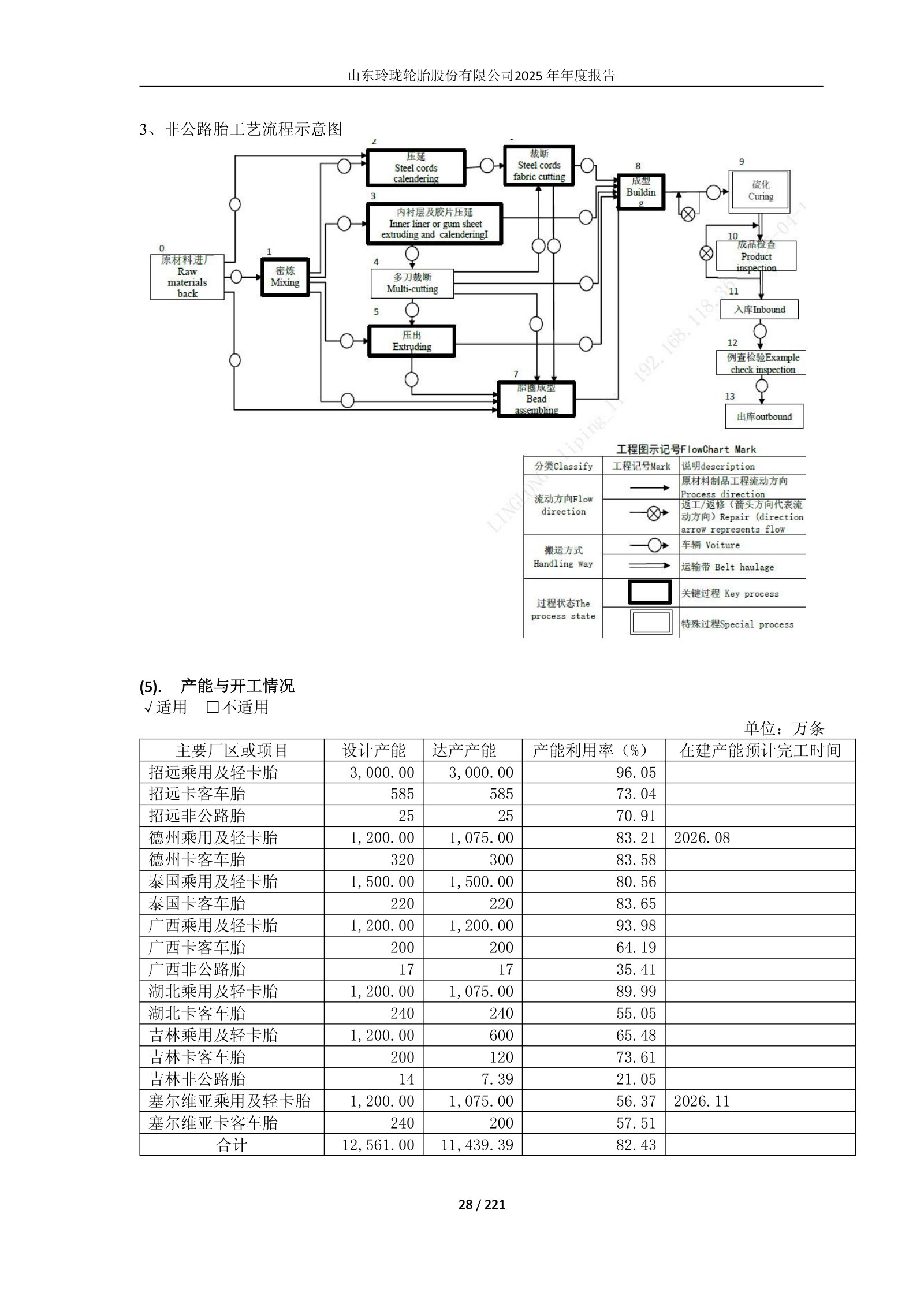
Linglong's inventory of the barriers facing Chinese tyre exports in 2025, and the broadest one in the peer set. The paragraph begins on page 10 and runs onto page 11 of the filing. It lists the US 10% baseline tariff imposed in April under a declared national emergency plus differentiated higher reciprocal rates on large-deficit partners; the EU anti-dumping investigation into passenger and light-truck tyres opened in May and the countervailing investigation added in November; Colombia's anti-dumping investigation into new Chinese truck and bus tyres opened on 21 October 2025; and the Eurasian Economic Commission's second sunset review of Chinese truck tyres of 17.5-24.5 inch rim diameter, opened 14 November 2025, under which existing duties of 14.79%-35.35% may continue. The item that reaches furthest into Prinx's own structure is the last: from September, Vietnam, Thailand and Malaysia began tightening enforcement against false country-of-origin declarations, with punitive tariffs of up to 40% on transshipped goods that fail a substantial-transformation test, stacking on top of existing US Section 232 and Section 301 duties. Prinx manufactures in Thailand and is building in Malaysia, so origin-rule enforcement in both jurisdictions is a live compliance and cost variable rather than a distant risk. This is Linglong's summary of measures rather than the legal instruments; the 40% figure is characterised as a maximum and is not attributed to a specific ruling. The same page also gives Linglong's market sizing — 1.207bn casings, up 1.72%; automotive tyre output 834m units, down 1.59%; all-steel 149m units, up 7.19%; semi-steel 684m units, up 1.33%; exports 472m units, down 0.64%, still 57% of automotive output — figures that do not reconcile with Triangle's on the same year.
2025 年,全球贸易环境面临严峻挑战,突出表现为“关税壁垒高企”与“绿色壁垒升级”的双重压力,共同构成了对企业出口成本、供应链管理能力和市场准入的系统性挑战。在关税方面,美国于 4 月以“国家紧急状态”为由对全球商品加征 10%基准关税,并对主要贸易逆差国实施差别化更高的“对等关税”,显著推高输美成本。同时,欧盟对乘用车及轻卡轮胎密集发起反倾销(5 月)和反补贴(11 月)调查。哥伦比亚 2025 年 10 月 21 日对原产于中国的新卡客车轮胎(税号 4011.20.10.00)启动反倾销调查。2025 年 11 月 14 日,欧亚经济委员会对华载重轮胎(轮辋直径 17.5-24.5 英寸)启动第二次日落复审,原税率 14.79%-35.35%可能延续。东南亚国家(越南、泰国、马来西亚等)自 9 月起严查“虚假原产地”,对未满足“实质性转化”的转口商品征收高达 40%的惩罚性关税,叠加美国原有的 232、301 等关税,形成多类、高额、叠加的税负壁垒。
p. 10 · Read in context →
Linglong's stated global plan, the "7+5" layout: seven domestic bases and five overseas, with a "3+3" off-road tyre programme embedded inside it — off-road capacity planned at three Chinese and three overseas bases. The rationale management gives is service radius to vehicle makers, faster delivery and localised R&D, manufacturing, marketing and service, aimed at a 2030 medium-term target. Two pages later the report identifies the components: Thailand as the first overseas base, in the WHA Eastern Seaboard industrial estate, described as strategically important and holding a warehouse adding over 1.2m tyres of storage since May 2021; Serbia as the European bridgehead and second overseas base; and Brazil as the third, planned with a 35 MW solar plant. Prinx's Thai base sits in the same Thai industrial-estate cluster and serves the same US and European replacement channels, so the overlap is direct. This is a strategy statement: the seven-plus-five count includes bases not yet built, and the capacity table earlier in this tab is the better guide to what is actually running.
基于加快构建以国内大循环为主体、国内国际双循环相互促进的新发展格局,公司推行“7+5”战略布局(即国内 7个基地、海外 5 个基地)。同时,为丰富产品种类,提升企业综合竞争力,公司又在“7+5”全球战略中嵌入“3+3”非公路轮胎产业布局(即在国内 3个基地、海外 3 个基地均规划建设非公路轮胎产能),对非公路轮胎领域进行全面升级。
通过“7+5”战略布局,在全球范围内形成与主机厂配套的最佳服务半径,亦可全面赋能零售服务体系,大幅提升交付效率,推进研发、管理、制造、营销、运营、服务的全球化、区域化和本土化发展,并通过人工智能、大数据、区块链、5G、工业机器人等尖端技术的应用,实现产品的全生命周期覆盖,使新建工厂的智能化水平、工艺设备先进程度达到国内领先、世界一流水平!未来公司将保持战略定力,向着 2030 年中长期发展目标坚毅前行。
p. 15 · Read in context →
Guizhou Tyre Co., Ltd. (贵州轮胎) (000589.SZ)
Prinx's nearest revenue twin among the A-share peers — FY2025 revenue of RMB10.95bn against Prinx's RMB11.81bn — and the closest match on product mix, running truck and bus radials alongside off-road, agricultural, industrial and bias tyres. Like Prinx it has one operating overseas base and a second under development, so its disclosures track the same decision Prinx is making with Malaysia. It also reports the industry capacity-load statistics that neither Prinx nor the other peers publish.
The oversupply evidence, from a peer's industry section. Guizhou cites the National Bureau of Statistics and Customs for 2025 Chinese rubber tyre casing output including motorcycle tyres of 1.207bn units, up 0.9%, and notes the growth rate narrowed by 8.3 percentage points against the prior year — the same headline number Triangle and General Science report, with the deceleration made explicit. Exports were 8.933m tonnes and US$21.52bn, up 2.9% by weight and 0.7% by value, so tonnage again grew four times faster than value. The second sentence is the one without an equivalent elsewhere in this tab: per the tyre branch's survey of key producers, average 2025 capacity load factors were 74.2% for all-steel and 79.5% for semi-steel, down 0.1 and 9.6 percentage points respectively. A near-ten-point fall in semi-steel loading is the industry backdrop against which Prinx's own semi-steel volumes grew 4.7% and its group gross profit fell 8.2%. These are survey averages across selected producers, not a census, and the association's series is not reconciled to the statistics-bureau output figure above it.
据国家统计局及海关总署公布的数据,2025 年我国橡胶轮胎外胎产量(含摩托车胎)达 12.07亿条,同比增长 0.9%,增幅较上年收窄 8.3 个百分点,增速较往年显著放缓。2025 年,我国累计出口轮胎 893.3 万吨和 215.2 亿美元,累计增幅为 2.9%和 0.7%。
据轮胎分会重点单位统计,2025年国内全钢胎和半钢胎平均产能负荷率分别为74.2%和79.5%,较上年分别下降0.1个百分点和9.6个百分点。
p. 16 · Read in context →
A peer's own placement in the two rankings this industry is scored on. In the China Rubber magazine "2025 Chinese Tyre Enterprise Ranking" published in August 2025, Guizhou Tyre placed 7th, up one position; in Tire Business's "2025 Global Tire 75", compiled on 2024 sales, it placed 24th, also up one. This is useful mainly as calibration: Guizhou reports FY2025 revenue of RMB10.95bn against Prinx's RMB11.81bn, so a company of Prinx's size sits around the top ten domestically and in the low-to-mid twenties globally. Both rankings are third-party compilations on revenue, published with a one-year lag in the Tire Business case, and neither measures share of any defined market. Sailun's exhibit above draws on the same Global Tire 75 for the top-three share figure.
在《中国橡胶》杂志社 2025年8 月公布的“2025 年度中国轮胎企业排行榜”中,公司排名第 7,较上年上升1 位。在美国《Tire Business》根据各企业 2024 年销售额发布的最新“2025 全球轮胎 75 强”中,公司排名第 24,较上一年度上升 1 位。
p. 10 · Read in context →
More peer documents
Jiangsu General Science Technology — 2024 Annual Report — FY2024 · 299 pages · Carries the same trade-barrier section a year earlier, including the January 2024 final determination on Thai passenger and light-truck tyres (Sentury Thailand 1.24%, Sumitomo Thailand 6.16%, 4.52% all-others) alongside the Prinx Chengshan 12.33% truck-tyre line — the two-product view of Thailand's US duty exposure. Page 35 has the prior-year plant utilisation table for the Thai and Cambodian bases. · Open →
Sailun Group — 2024 Annual Report — FY2024 · 259 pages · The 2024 baseline for the market sizing used above: page 16 puts Chinese automotive casing output at 847m units, up 7.8%, with all-steel truck tyres at 139m units, down 4.1%, and cites Michelin for a 36.7% top-three global share in 2023, down 2.2 points — the prior reading of the 35% figure in the exhibit above. · Open →
Sailun Group — investor relations record, results briefing of 21 May 2025 — Q1 FY2025 · 7 pages · Question 15 gives installed annualised overseas capacity plant by plant — Vietnam 2.6m all-steel, 16m semi-steel and 100k tonnes off-road excluding the ACTR joint venture; ACTR 2.65m all-steel; Cambodia 1.65m all-steel and 19m semi-steel — the installed counterpart to the planned figures quoted in this tab. · Open →
Sailun Group — investor relations record, results briefing of 4 November 2025 — Q3 FY2025 · 9 pages · Question 9 is the clearest peer statement on the EU investigation's second-order effect: Sailun says its EU-bound semi-steel orders have already moved to overseas plants and that domestic production remains export-led, which is the competitive pressure Prinx's Shandong base faces. Question 4 covers the off-road build-out against Linglong's 63-inch giant tyre. · Open →
Sailun Group — investor relations record, results briefing of 8 May 2026 — Q4 FY2025 · 16 pages · The most recent peer commentary in the set. Management states it has already raised prices in response to rising raw-material costs, sets out the Egyptian plant's 9m semi-steel and 1.65m all-steel target, and describes the channel build across 180-plus countries — the pricing and channel questions a Prinx reader carries into 2026. · Open →
Shandong Linglong Tyre — 2024 Annual Report — FY2024 · 234 pages · Page 27 has the prior-year version of the plant capacity table used above, which is what turns it into a trend: Thai passenger utilisation was 97% in 2024 against 80.56% in 2025, and Thai truck 46% against 83.65% — a large swing in the base most comparable to Prinx Thailand. · Open →
Triangle Tyre — 2024 Annual Report — FY2024 · 159 pages · The base year for the 18% replacement collapse quoted above. Page 27 carries the same plant-level capacity table, showing 26.88m sets of design capacity at 91.20% blended utilisation in 2024 against 89.61% in 2025, with the commercial-tyre plant at 89.91% falling to 88.88%. · Open →